
Operational Transparency Stack

The Operational Transparency Stack

No single standard covers transparency from start to finish. The Operational Transparency Stack puts the open standards and law in order, in seven layers. The Transparency by Default Code of Practice sits on top: the Code states the conduct, and the Stack is what it rests on.

What it is

A map of the standards

Engineers can point to the layer of the internet where something happens. Privacy has had no such map.

The Operational Transparency Stack is that map for transparency. It shows which standard does which job, from privacy principles, through notice and consent, to the records that show what took place.

Read: The Transparency Stack, and where it sits on the OSI model

The layers

What each layer does.

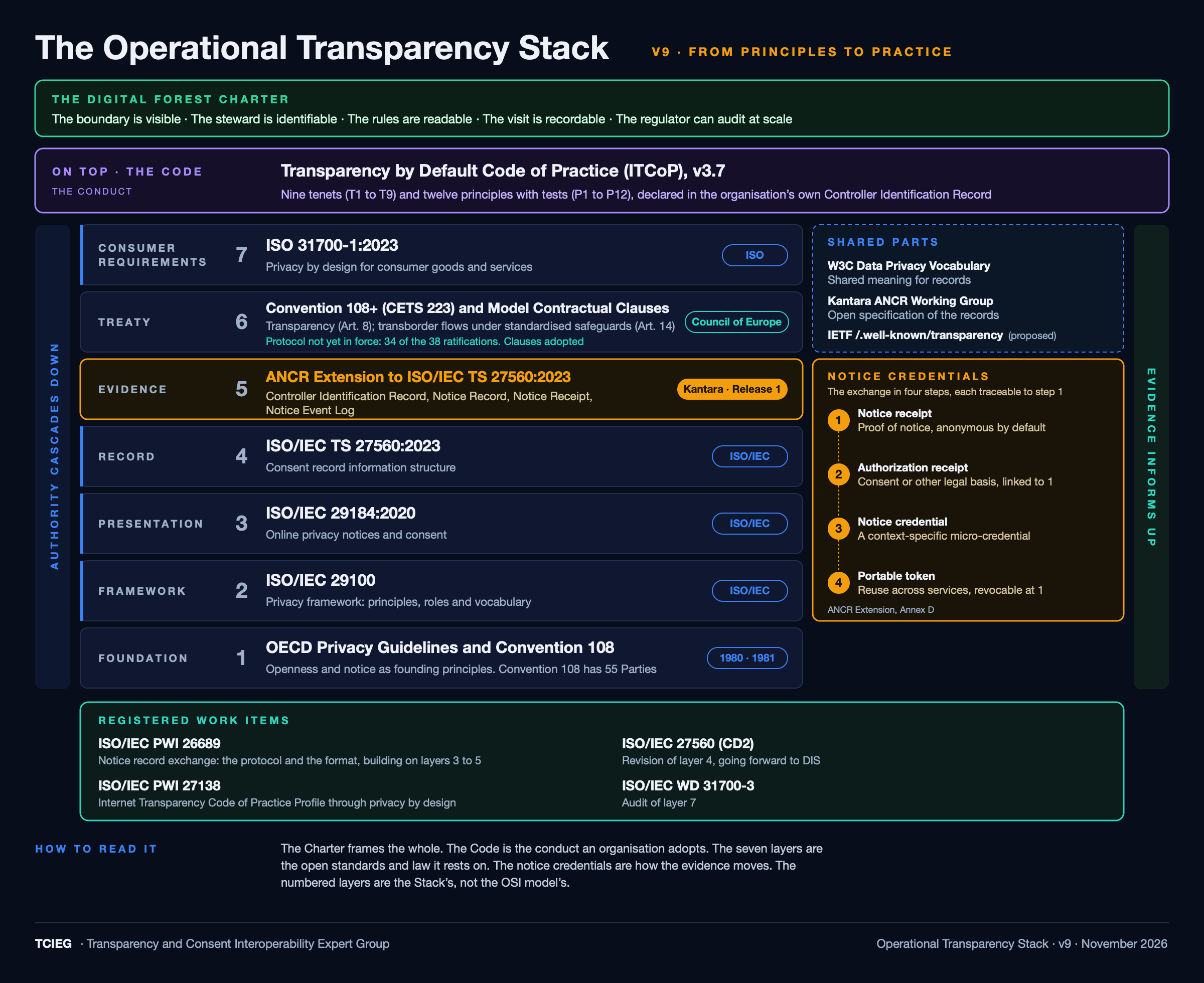
The Operational Transparency Stack v9: the Digital Forest Charter frames the whole; the Transparency by Default Code of Practice sits on top; seven layers from the OECD Privacy Guidelines and Convention 108 to ISO 31700-1, with layer 5, the ANCR Extension, highlighted; beside them the notice credentials in four steps and the shared parts; four registered work items below
  1. Foundation: OECD Privacy Guidelines (1980) and Convention 108 (1981)

    Openness and notice as founding principles. Convention 108 has 55 Parties.

  2. Framework: ISO/IEC 29100

    Sets the principles that everything else rests on, including openness, transparency and notice, with the roles and vocabulary.

  3. Presentation: ISO/IEC 29184:2020

    Sets the controls for how a privacy notice is presented and how consent is asked for.

  4. Record: ISO/IEC TS 27560:2023

    Sets the information structure for recording consent. Under revision: CD2 is going forward to DIS.

  5. Evidence: ANCR Extension to ISO/IEC TS 27560:2023, Release 1

    Adds the Controller Identification Record, the versioned Notice Record, the Notice Receipt and the Notice Event Log, with jurisdiction and transfer fields. The receipt is anonymous by default and binds the disclosure event to the accountable controller and the applicable notice version.

  6. Treaty: Convention 108+ (CETS 223) and the Model Contractual Clauses, Module 1

    Transparency (Art. 8) and transborder flows under approved standardised safeguards (Art. 14). The amending Protocol (CETS 223) is not yet in force, at 34 of the 38 ratifications; the clauses are adopted.

  7. Consumer requirements: ISO 31700-1:2023

    Privacy by design for consumer goods and services: the high-level requirements.

On top of the seven layers

The Transparency by Default Code of Practice (ITCoP), v3.7

The conduct an organisation adopts: nine tenets, from authority and accountable party first (T1) to every processing activity recorded and logged (T9), and twelve principles, each with a test. Each tenet rests on a layer of the Stack, and each is shown by a record an organisation publishes or a person holds.

An organisation declares the Code in its own Controller Identification Record, so anyone can see which version it follows and what it claims.

Registered work items

Where the work is going.

  • ISO/IEC 27560, CD2 (SC 27/WG 5)

    Going forward to DIS: the revision of layer 4.

  • ISO/IEC PWI 26689 (SC 27/WG 5)

    How notice records are exchanged between systems, the protocol and the format, building on layers 3 to 5.

  • ISO/IEC PWI 27138 (SC 44/WG 1)

    Internet Transparency Code of Practice Profile through privacy by design: requirements on the organization, a companion to layer 7.

  • ISO/IEC WD 31700-3 (SC 44/WG 1)

    The audit of layer 7.

The seven layers hold open standards and law. The Code sits on top of them. Shared vocabularies, open specifications and the well-known address are listed under Stack Standards.

The records

Records you can inspect

Controller Identification Record

The Controller Identification Record is published before any personal data is exchanged. It says who the controller is and how to reach them.

Notice Record

The notice itself, kept by version, so anyone can check exactly what was shown.

Notice Receipt

Evidence, held by the individual, that the notice was given. Available without being required to identify yourself.

Notice Event Log

A running record of each notice event over the life of the relationship.

Contact us

Talk to TCIEG

TCIEG welcomes discussion with regulators, standards participants, civil society, technology providers, legal experts, privacy engineers and implementation practitioners working toward interoperable Operational Transparency standards.

Contact us